

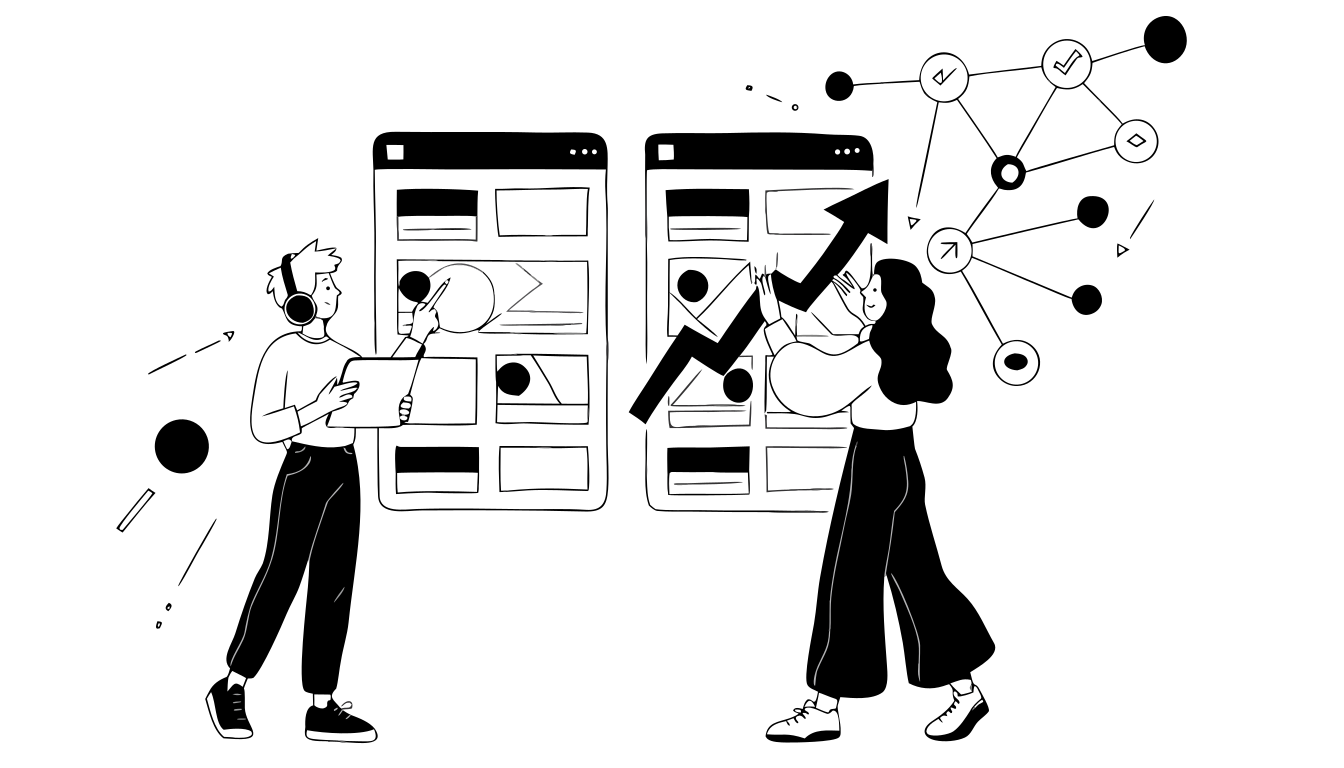
Ask most business owners what drives performance marketing results, and they'll say "targeting" or "budget." Ask the best media buyers in the industry, and they'll give you a different answer: creative.
In 2026, the single most impactful lever in paid advertising is not your bid strategy, your audience segmentation, or even your budget, it's the quality and variety of your ad creative. And the tool that separates good creative from great creative is relentless, data-driven A/B testing.
At our company, A/B testing is a core service we provide alongside campaign management, landing page development, and tracking implementation. Here's why we consider it the most underrated, and most profitable, investment our clients can make.
The Shift That Changed Everything
For years, performance marketers controlled campaign outcomes through manual levers: custom audiences, bid adjustments, placement selections, and budget allocation. The marketer was the pilot.
That era is over.
Platforms like Google, Meta, TikTok, and YouTube have systematically removed manual controls in favor of AI-driven automation. Google's Performance Max campaigns don't let you choose keywords. Meta's Advantage+ products override your audience selections when the algorithm thinks it can do better. Manual targeting options are shrinking across every major platform.
What remains firmly in the marketer's control? The creative inputs: the images, videos, headlines, ad copy, and landing pages that feed the algorithm. In a world where AI handles distribution, creative quality determines performance.
This is backed by real data. Campaign experiments consistently show that creative variation affects engagement far more than audience changes. When we run campaigns for clients across verticals like eCommerce, SaaS, Credit Cards, or Background Checks, the performance gap between the best and worst creative variants within the same campaign often exceeds 300%.
What A/B Testing Actually Looks Like at Scale
A/B testing in performance marketing isn't about changing a button color and waiting two weeks. At the scale we operate, it's a systematic, continuous process of creative experimentation:
Ad Creative Testing
We test multiple dimensions simultaneously:
- Hook variations: The first 1-3 seconds of a video ad or the headline of a static ad. This single element determines whether someone stops scrolling.
- Visual formats: Static images vs. carousels vs. short-form video vs. UGC-style content. Different formats perform differently across channels and verticals.
- Messaging angles: Pain-point-driven copy vs. benefit-driven copy vs. social proof vs. urgency. Each resonates with different audience segments.
- Call-to-action language: "Get Your Free Quote" vs. "See If You Qualify" vs. "Compare Rates Now". Subtle differences produce measurable conversion lifts.
We typically launch 10-20 creative variations per campaign, then use performance data to quickly identify winners and kill underperformers. The winning creatives get scaled; the insights from losers inform the next round of testing.
Landing Page Testing
The ad is only half the equation. What happens after the click matters just as much. Our landing page A/B tests cover:
- Headline and subheadline messaging
- Form length: Every additional field reduces conversions, but shorter forms can reduce lead quality. The right balance depends on the vertical.
- Page layout and information hierarchy: Does the trust section come before or after the form? Is pricing visible or hidden?
- Social proof placement: Testimonials, partner logos, and review counts placed near the CTA consistently outperform pages without them.
- Page load speed: We optimize for less than 1 second load times. In mobile-heavy verticals, this alone can improve conversion rates by 15-20%.
Tracking and Measurement
None of this works without proper measurement infrastructure. That's why we build pixel and S2S tracking, Google Tag Manager configurations, and custom conversion events for every client. You can't optimize what you can't measure, and you can't A/B test reliably if your tracking is leaky.
The Compounding Effect of Creative Iteration
Here's what makes A/B testing so powerful: the gains compound.
Imagine you run an initial batch of creative tests and find a winning ad that converts 20% better than your baseline. You scale that winner, then test new variations against it. The next winner beats the first by another 15%. Over three months of continuous iteration, your effective cost per acquisition has dropped by 40%, without increasing your budget by a single dollar.
This is exactly what we see across the hundreds of campaigns we've launched at our company. Clients who invest in ongoing creative testing consistently outperform those who launch a campaign and let it run unchanged. Campaign fatigue is real: even winning creative degrades over time as audiences get saturated. Continuous iteration keeps performance fresh.
Why Most Companies Get This Wrong
Despite its importance, most companies underinvest in creative testing for three reasons:
They lack the volume of creative assets. Producing 20 ad variants requires design resources, copywriting capacity, and video production capability. At our company, we handle ad creation, both images and videos, as part of our service offering, removing this bottleneck.
They don't have the tracking infrastructure. Without clean, reliable conversion data, A/B test results are meaningless. Our team implements pixel tracking, S2S integration, and Google Tag Manager setups to ensure data integrity.
They optimize too slowly. In performance marketing, speed matters. Waiting 2 weeks to evaluate a test that should have been called in 3 days wastes budget. We use statistical rigor combined with real-time monitoring to make fast, confident decisions.
AI + Human Judgment: The Winning Combination
AI-powered platforms are excellent at optimizing delivery once they have a winning creative. But they can't generate the creative strategy itself. They don't understand your brand positioning, your competitive landscape, or the emotional triggers that drive your specific audience.
The best results come from pairing AI's distribution intelligence with human creative judgment. We develop the hypotheses, craft the creative variants, and design the tests. The algorithm handles the rest. This collaboration between human strategy and machine execution is where performance marketing delivers its greatest returns.
Start Testing Today
If you're running paid traffic campaigns without a structured A/B testing program, you're leaving money on the table. The data is clear: creative experimentation is the highest-ROI activity in performance marketing in 2026.


